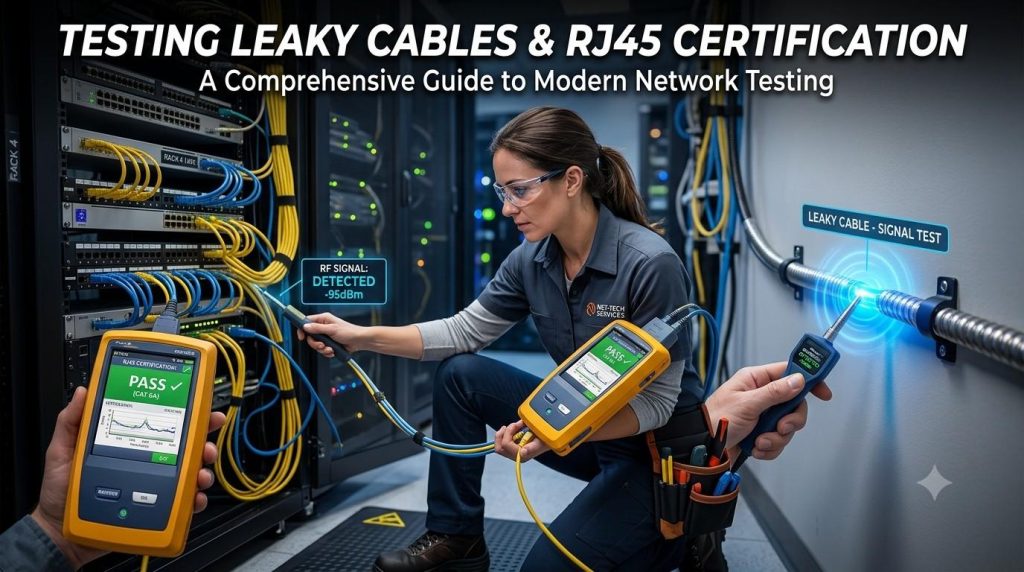
What Are Leaky Cables and Why Do They Need Specialized Testing?
Leaky cables, technically called radiating cables, are kinda not your normal coaxial cables. They’re engineered to leak or radiate signals outward, not really keep the energy trapped inside. What makes them special, you know, is a few key things. First, they have precision-cut slots in the outer conductor. Next, they can work like a long, flexible, distributed antenna system instead of behaving like a neat little straight feed. They also help deliver seamless wireless coverage in places where conventional antennas, somehow just don’t cut it. You’ll usually find them deployed in tunnels mines , underground railways, or big warehouses where coverage is tricky to maintain. And since leaky cables are made to intentionally allow signal radiation, the testing process can’t be the same as testing standard shielded cables. ATS Test Labs has the tools and technical know-how to support both radiating cable assessments and full RJ45 copper cable certification, all under one roof.Why RJ45 Cable Testing Cannot Be Skipped?
RJ45 cables move data between computers, switches, routers and basically all the other communication devices in your network. Even a small defect in one single cable run can lead to a not very fun situation like a complete network outage for that segment, plus packet loss followed by retransmission delays. You might also see slower throughput, which hits productivity, and then there’s the usual unstable, intermittent communication that feels random.The tricky part is that many cable faults are pretty invisible to the eye. A run can look like it was perfectly installed, but still fail once real network load kicks in. That’s exactly why ATS Test Labs does instrument-level certification testing rather than depending on visual inspection only.Common RJ45 Cable Defects That Fail Certification
During installation and long-term usage, RJ45 cables develop faults that directly impact network performance. At ATS Test Labs, our DSX-5000 testing identifies every one of these defect types:| Defect Type | What It Causes | Detected By DSX-5000 |
| Open Circuit | Complete signal break on one or more pairs | Wire Map test |
| Short Circuit | Two conductors making unintended contact | Wire Map test |
| Split Pairs | Wrong pair connections causing crosstalk | Wire Map + NEXT |
| Improper Termination | Poor punch-down causing signal degradation | Return Loss test |
| Excessive Cable Length | Signal attenuation beyond limits | Cable Length test |
| High Insertion Loss | Signal weakening over the run | Insertion Loss test |
| Return Loss Issues | Signal reflections from impedance mismatches | Return Loss test |
| Crosstalk (NEXT/PSNEXT) | Signal interference between adjacent pairs | NEXT/PSNEXT test |
| Damaged Connectors | Physical breaks causing intermittent faults | Wire Map test |
| Bent or Crushed Cables | Permanent physical damage to cable geometry | Multiple parameters |
What Proper Cable Certification Guarantees You
When ATS Test Labs certifies your cable installation, you end up with written proof of stable network communication across every tested run, plus the ability to deliver high-speed data transfer at the rated category level. You also cut down on troubleshooting time , because problems get identified and handled before go-live. On top of that, you meet international standards that manufacturers and insurers tend to require, and your install quality goes up thanks to those detailed fault location reports. It’s also more reliable over the long term , since the performance is backed by actual test records.If you skip formal cable certification, though, those hidden faults can stay unnoticed inside walls , ceilings, and conduits. Later, when they finally show up months down the line, the expense for diagnosis and remediation is almost always way more than the original testing spend.The Fluke Networks DSX-5000 Cable Analyzer: The Industry Standard Tool
ATS Test Labs, uses the Fluke Networks DSX-5000 Cable Analyzer for all copper cable certification, basically. It’s the same instrument used by Tier 1 network contractors around the world , and it’s also the tool that major structured cabling manufacturers say they need for warranty validation.Cable Categories that the DSX-5000 certifies- Cat 5e, 100 MHz bandwidth
- Cat 6, 250 MHz bandwidth
- Cat 6A, 500 MHz bandwidth
Critical Parameters Measured During Every Test
| Parameter | What It Measures | Why It Matters |
| Wire Map | Correct pin-to-pin connections across all 8 conductors | Confirms proper termination and no crossed pairs |
| Cable Length | Physical length of each cable run | Ensures compliance with 100-metre channel limit |
| Insertion Loss | Signal attenuation from end to end | Confirms signal strength at the receiving device |
| Return Loss | Signal reflected back from impedance changes | Identifies poor terminations and connector issues |
| NEXT | Near-End Crosstalk between adjacent pairs | Detects interference at the transmit end |
| PSNEXT | Power Sum Near-End Crosstalk across all pairs | Full multi-pair interference assessment |
| Propagation Delay | Time taken for signal to travel the cable length | Ensures timing compliance for network protocols |
| Delay Skew | Difference in propagation delay between pairs | Critical for Gigabit and 10G Ethernet performance |
How ATS Test Labs Conducts Cable Certification?
At ATS Test Labs, our cable testing process sort of follows a structured workflow, you know, not just random checks or anything. Step 1: Site Assessment. Our technicians review the cable layout, identify all runs to be certified , and confirm cable category with the installation team. Step 2: DSX-5000 Configuration. The analyzer gets configured for the right cable category, the chosen test limit standard, and the NVP (Nominal Velocity of Propagation) value, so the length measurement stays accurate. Step 3: Full Parameter Sweep. Every cable run gets a complete test across all eight parameters listed above, and the DSX-5000 measures bidirectionally for full accuracy. Step 4: PASS/FAIL Analysis. Results are reviewed immediately . If there’s a FAIL result , it is investigated , the fault location is pinpointed using the DSX-5000 distance-to-fault feature , then the cable is remediated or replaced. Step 5: Certification Report Delivery. You receive a complete test report for every cable run, which is suitable for manufacturer warranty claims, project handover documentation, and compliance records.Why Network Teams in Bengaluru Choose ATS Test Labs
ATS Test Labs kinda works like a one-stop solution for cable testing and certification in Bengaluru, you know , the full stop kind of thing. What kinda sets it apart is this- Fluke Networks DSX-5000 is used on pretty much every copper cable project
- Certified technicians with hands-on experience across Cat 5e, Cat 6, and Cat 6A installations
- Test results that stay in line with the usual international TIA/EIA plus ISO/IEC limits
- Quick turnaround for both the testing part and the report delivery too
- Reports with detailed fault location information, so your team doesn’t just guess what to fix
No Comments yet!